
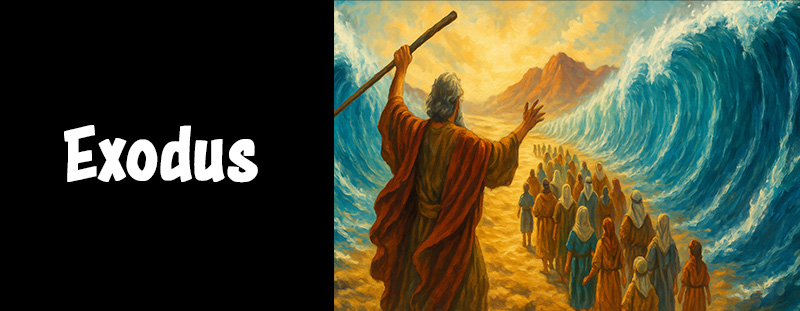
🌅 Remembering Deliverance: The Firstborn and the Path to Promise 🌅
“And the Lord spake unto Moses, saying, Sanctify unto me all the firstborn, whatsoever openeth the womb among the children of Israel, both of man and of beast: it is mine.” – Exodus 13:1-2
Exodus 13 marks a sacred turning point in Israel’s story — the moment when remembrance becomes a command and freedom becomes a path of faith. After the final plague and Pharaoh’s surrender, God instructs His people to consecrate their firstborn and commemorate their deliverance through the Feast of Unleavened Bread. This chapter beautifully ties remembrance to obedience, showing how God leads His people not by the shortest route, but by the safest one — the way through the wilderness.
Through these verses, we witness the heart of covenant living: gratitude, obedience, and trust in God’s direction.
📜 Structure of Exodus Chapter 13
Verses 1–2: Consecration of the Firstborn
God commands Moses to set apart every firstborn male, human and animal, as belonging to Him. This act of consecration is both remembrance and recognition — a sign that Israel’s deliverance came at the cost of Egypt’s firstborn. Every future generation would be reminded that their lives were redeemed by divine mercy.
Verses 3–10: The Feast of Unleavened Bread
Moses instructs the people to observe the annual Feast of Unleavened Bread as a lasting memorial of God’s mighty hand bringing them out of Egypt. They are to eat no leavened bread for seven days, symbolizing purity and separation from their past bondage. The feast becomes a living lesson for their children, teaching them that obedience keeps faith alive across generations.
Verses 11–16: Redemption of the Firstborn
Here the principle of redemption is explained. Every firstborn donkey must be redeemed with a lamb, and every firstborn son must be bought back with a sacrifice. This exchange teaches the deep truth that God’s people live because of substitution — a pattern that points prophetically toward the ultimate Redeemer, Christ.
Verses 17–18: The Route Through the Wilderness
Rather than leading Israel by the direct road through Philistine territory, God chooses a longer path through the wilderness. He knows their hearts and protects them from discouragement and fear of war. The route may be longer, but it is guided by wisdom — a reminder that divine detours are never mistakes.
Verses 19–22: Joseph’s Bones and God’s Presence
Moses carries Joseph’s bones out of Egypt, fulfilling a promise made generations earlier. God’s presence goes with them in a pillar of cloud by day and a pillar of fire by night, guiding and guarding His people every step of the way. This powerful image reveals that deliverance is not merely escape — it is the beginning of a relationship marked by visible, guiding grace.
💡 Key Themes
✨ Consecration and Remembrance
God calls His people to set apart their firstborn as a sign of gratitude and remembrance. Consecration is not a one-time act but a continual reminder that life itself belongs to God.
✨ The Power of Redemption
Every act of redemption in this chapter points toward the greater story of salvation. The lamb that redeems the donkey prefigures the Lamb of God who redeems all humanity.
✨ God’s Guidance and Protection
The pillar of cloud and fire symbolize God’s faithful direction. Even when the path seems uncertain, His presence never leaves His people.
✨ Obedience as Worship
Israel’s obedience to these rituals transforms remembrance into worship. Faith is sustained by faithful action — not just memory, but practice.
👤 Key People
- Moses – The faithful leader who carries both God’s commands and Joseph’s bones, bridging the promises of the past with the hope of the future.
- The Israelites – Newly freed from Egypt, they learn to walk by faith, not sight.
- Joseph – Though long dead, his faith still speaks; his bones remind Israel that God always fulfills His promises.
🔥 Why This Chapter Matters
Exodus 13 teaches that freedom requires formation. God doesn’t just rescue His people — He teaches them how to remember, worship, and walk in faith. The consecration of the firstborn, the feast, and the journey all echo one truth: redemption demands remembrance.
Through this chapter, we see that God’s deliverance is not only about escaping Egypt, but about learning to live as His own.
💭 Let’s Reflect
- How do you remember God’s deliverance in your life today?
- What “detours” in your journey might actually be divine protection?
- In what ways can obedience and remembrance shape your worship?
❓Ready to Go Deeper?
👉 Click here to begin reading Exodus Chapter 14
Or, if you’d like to jump to a specific chapter in Exodus, simply click the chapter number below:
1 | 2 | 3 | 4 | 5 | 6 | 7 | 8 | 9 | 10 | 11 | 12 | 13 | 14 | 15 | 16 | 17 | 18 | 19 | 20 | 21 | 22 | 23 | 24 | 25 | 26 | 27 | 28 | 29 | 30 | 31 | 32 | 33 | 34 | 35 | 36 | 37 | 38 | 39 | 40